
Margery Kempe: Author, Pilgrim, Mystic
On a night, as this creature lay in her bed with her husband, she heard a sound of melody so sweet and delectable, that she thought she had been in Paradise, and therewith she started out of her bed and said: “Alas, that ever I did sin! It is full merry in Heaven.”
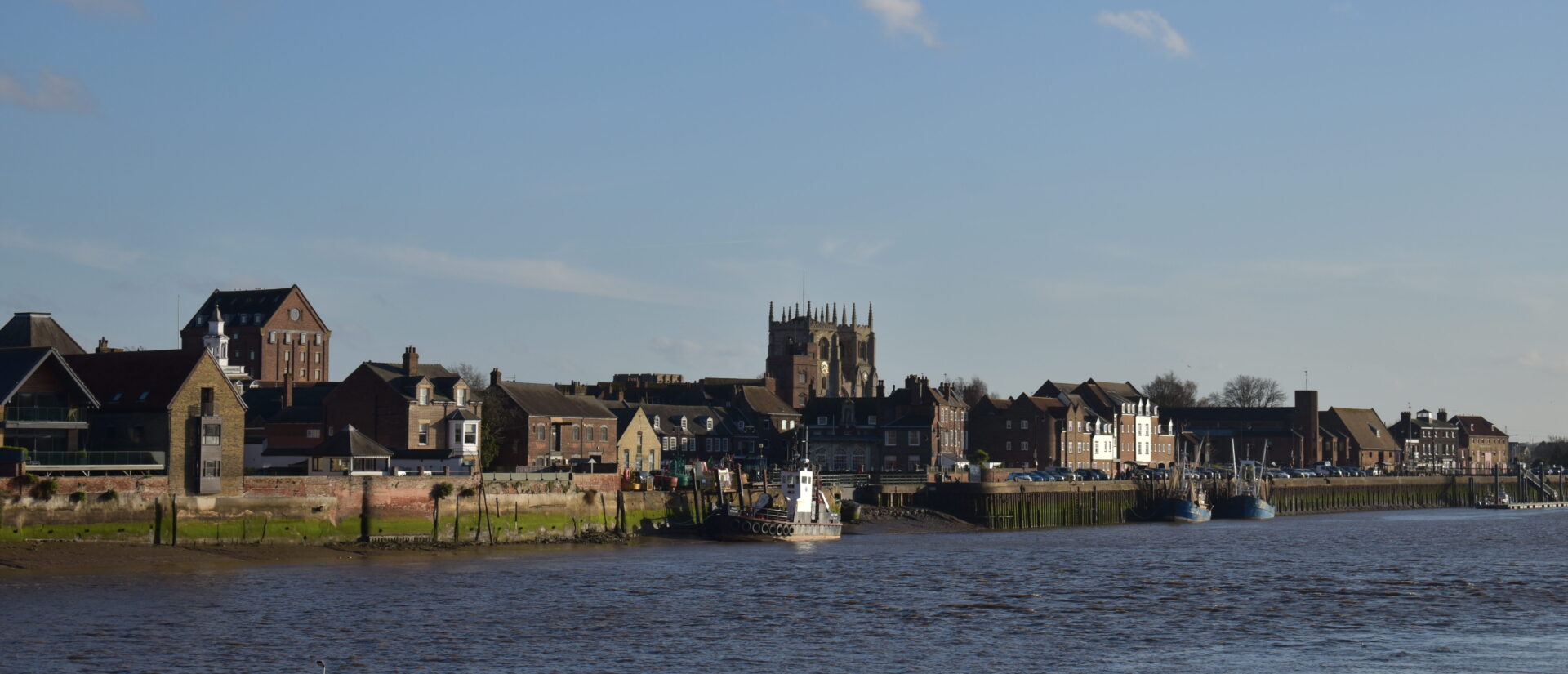
Margery was born around 1373 in Bishop’s Lynn (now King’s Lynn) to a distinguished family. At this time the port was an important part of the Hanseatic League, a network of European cities around the Baltic connected through trade. Traders had the right to move easily between the cities. Due to her family background and the environment in which she lived, Margery would have had numeracy and literacy skills. She would have attended St Margaret’s Church (now King’s Lynn Minster) regularly. At this time Bishop’s Lynn was awash with preachers, monks and friars and she says she learnt a great deal from them. Her father was a major trader and five times mayor of Bishop’s Lynn among other key roles. He owned a house in Briggate (now the High Street) and his children may have grown up there. Margery married John Kempe, who was also from a merchant family, when she was twenty. The couple lived in a house in Fincham Street (now New Conduit Street). Her first pregnancy was traumatic, both physically but also mentally to the point that she scratched at herself leaving scars. Margery fears that she was trapped in sin, the nature of which is not revealed, and that her pain is the punishment. The visions started at this time, consisting of demons encouraging her to commit suicide so she would go to hell. Another was of Christ, appearing to her clad in purple and comforting her, saying ‘daughter, why have you forsaken me when I never forsook you?’ She went on to have thirteen more children.
The 12th century saw the emergence of female mysticism in northern Europe. The early mystics, such as Hildegard of Bingen, were nuns but soon ordinary women became known for their intense spirituality, such as Marie of Oignies, and their visions were written down by priests. However, women did not have a place in established hierarchy. Their visions were considered problematic due their perceived intellectual and moral failings, and it was feared that they would not be able to identify whether the origin of the visions was good or evil. Some thought Margery’s visions were due to mental illness but she writes that she is not ill and that she actually touches Christ. The Oxford cleric John Wycliffe criticised confession, indulgences, clerical celibacy and devotion towards relics, and this position became known as Lollardy. Margery was accused of Lollardy many times but successfully defended herself. However, she paid for indulgences and believed in Transubstantiation (i.e. the sacrament becomes the literal body and blood of Christ). As an independent holy woman who was highly visible there was some anxiety surrounding the example she was setting to other women, as opposed to anchorites who lived in cells. In accordance with the teachings of St Paul, women were forbidden from preaching.

Margery was a frequent visitor to her parish church, which she describes in her book as a ‘a stately place and richly honoured.’ In January 1421 a fire broke out in Bishop’s Lynn and damaged the guildhall of the Holy Trinity Guild on the Saturday Market Place. Margery describes herself as weeping and praying that St Margaret’s Church would be saved. Her fellow parishioners often complained about her constant weeping.
When her crying had passed, she came before the Archbishop and fell down on her knees, the Archbishop saying full boisterously unto her: “Why weepest thou, woman?” She, answering, said: “Sir, ye shall wish some day that ye had wept as sore as I.”
Margery receives more visions fifteen years after the first batch, this time consisting of longer conversations with Christ. He reassures her that she is saved and her sins have been forgiven. Margery is moved to loud public displays of sobbing, writhing and wailing. In other visions, Margery imagines herself looking after the Virgin Mary as her servant, accompanies her on a visit to her cousin Elizabeth and assists with the birth of Christ. It is at this time that her ministry starts in earnest and she travels around the country sharing her message. Christ suggests she visit the anchorite, Julian of Norwich, and the two women spend several days together. In 1413 Margery makes a pilgrimage to Jerusalem where she is ostracized by fellow pilgrims and her servant. The mocking only serves to strengthen her resolve. Pilgrimages to Santiago de Compostela, Rome and Germany followed. She received many offerings which she gave away in order to make her pilgrimages more challenging.
During a visit to Leicester, a vividly painted crucifix made Margery sob uncontrollably. The mayor arranged for her to be interrogated in the crowded church but her beliefs were found to be sound. Similar events unfolded at York Minster. Margery was able to obtain an official letter from the Archbishop of Canterbury to allay the fears of those who may accuse her of being a heretic. In her book she describes the criticism she faced and thanks people for their scorn as she is glad to be suffering in God’s name.
Margery dictated her visions to scribes and the result was The Book of Margery Kempe. Early printed versions were produced in 1500 and 1521 but these were heavily edited. Margery was forgotten until 1934 when the full version was discovered and subsequently published in modern English. The manuscript was held by the Carthusian monks of Mount Grace in Yorkshire in the late 15th century and they made annotations in the margins. It is rich in biblical citations of suffering and Old Testament prophecy with a focus on the carnality of the doctrine of incarnation. The new version generated great enthusiasm amongst both Catholics and Protestants for this colourful English religious character (her only English counterpart being Julian of Norwich). Her writings provide an extraordinary insight into the experience of a middle class woman in the Middle Ages.


A sculpture of Margery, entitled ‘A Woman in Motion’, was created by Rosemary Goodenough and installed in King’s Lynn Minster in 2023 to commemorate the 650th anniversary of her birth. Rosemary explains:
“Although in the Book of Margery Kempe she is completely honest and open about her love of fine clothes and her competitiveness with other women’s finery, as a pilgrim her clothes were pretty ragged and patched and at one point on returning back to Bishop’s Lynn she was desperately poor. Having given away all her money, she was given a bolt of white fabric by an ‘honourable man in Norwich.’ I have therefore made her clothes, although plentiful, very clearly torn and patched but still with an element of grace and elegance. As pilgrims of her era were advised to wear a very wide brimmed hat, I have depicted her wearing one. Given her determination to wear white, for which she was persecuted and prosecuted, I have made her robes white but her dress is silvery aluminium as I wanted to give a nod to her love of finery. Her hands are tucked inside her robes as she was so terrified of being burned at the stake that, although determined to fight her corner, her hands shook so badly she hid them in order to appear to be stronger than she actually felt when speaking in her own stout defence about wearing white. The way the light will shine through the stained glass windows and play on her clothes at certain times adds another element of beauty and spiritual feeling. Margery’s head is bent in prayer and her ‘top-knot’ is my way of denoting her indomitable spirit, both secular and religious as described in Anthony Bale’s book about her wish to live A Mixed Life.”
 King's Lynn
King’s Lynn Minster (St Margaret), King’s Lynn
St Margaret's Place, Saturday Market Place, King's Lynn, PE30 5DQ


